Your posts are set, the concrete has cured, and your fence line is starting to take shape. This is the part where it actually starts looking like a fence — rails go on first, then the panels or pickets slot into place, and the whole thing comes together relatively quickly. If you've done the hard work of getting your posts plumb and in line, this stage is the reward.
This guide walks through installing rails, fitting panels or pickets, cutting panels to size, hanging gates, and doing your final checks. It's the last step in the build sequence, and it's the most satisfying one.
In this guide:
This is part of our DIY fencing series. If you're just getting started, read the planning guide first, then how to set a string line and how to set PVC fence posts. This guide picks up where the posts article left off.
Before You Start — Check Your Posts
Before you pick up a single rail, go back along the fence line and check a few things. It's much easier to deal with a problem now than after you've got panels in place.
- Are all posts plumb? Check each one with a spirit level on two faces (front-to-back and side-to-side). Even a small lean will show up once the panels are on.
- Are all posts at the right height? Look along the top of the fence line. If you're on flat ground, the post tops should all be at the same height. On a slope, they should step evenly.
- Has the concrete fully cured? Standard concrete needs 24 to 48 hours before you start putting load on the posts. Quick-set products firm up faster — typically one to two hours — but check the manufacturer's instructions. If the posts feel loose or shift when you push them, give it more time.
- Is your string line still in place? If you took it down after setting posts, run it back along the tops of the posts to check alignment. You want a straight, consistent line from end to end.
If something is off, now is the time to sort it out. A post that's slightly out of plumb or out of line will affect every panel in that bay.
Plan Your Panel Layout
Before you start fitting anything, lay out all your panels on the ground along the fence line in the order they'll go up. This gives you a chance to see the full run and catch any issues before they become problems.
- Check which panels go where. If you have different styles going in different sections — for example, privacy panels along the back boundary and pickets along the side — make sure each set is in the right spot before you start.
- Work out which panels need cutting. Unless your fence line divides perfectly by the panel width, the last panel in each run will need to be trimmed. Identify those panels now and mark them.
- Check for gates. Gate openings break the panel run, so make sure you know where each gate sits and that the adjacent panels are the right size to fill the remaining gaps.
This takes 10 minutes and saves you from discovering halfway through that a panel is in the wrong section or you've run one short.
Installing Rails
Rails are the horizontal pieces that connect between the posts and support the panels or pickets. PVC fence posts have channels or grooves routed into them — the rails slide into these channels.
How it works
Start with the bottom rail. Slide one end into the channel on the first post, then slide the other end into the channel on the next post. Most PVC rail systems have an aluminium insert inside the rail for strength — make sure this is in place before you fit the rail.
Once the bottom rail is in, fit the top rail in the same way. On a standard privacy fence, there will be a top rail and a bottom rail. Some styles have a middle rail as well — check your product specifications.
Getting it right
- Check each rail with a spirit level. The rail should sit level between the posts. If it's not level, the panels above it will sit unevenly, and you'll see it from across the yard.
- Rails should be snug but not forced. They're designed to slide into the post channels smoothly. If you're having to hammer a rail into the post, something is wrong — check that the rail is the right way up, that the aluminium insert is seated properly, and that nothing is blocking the channel.
- Leave a small gap for movement. PVC expands and contracts slightly with temperature changes. Don't jam the rails hard up against the end of the channel — leave a few millimetres of room so the rail can move without bowing.
Rails on a slope
If your fence runs along sloping ground, you'll have one of two setups depending on what you planned during the post-setting stage.
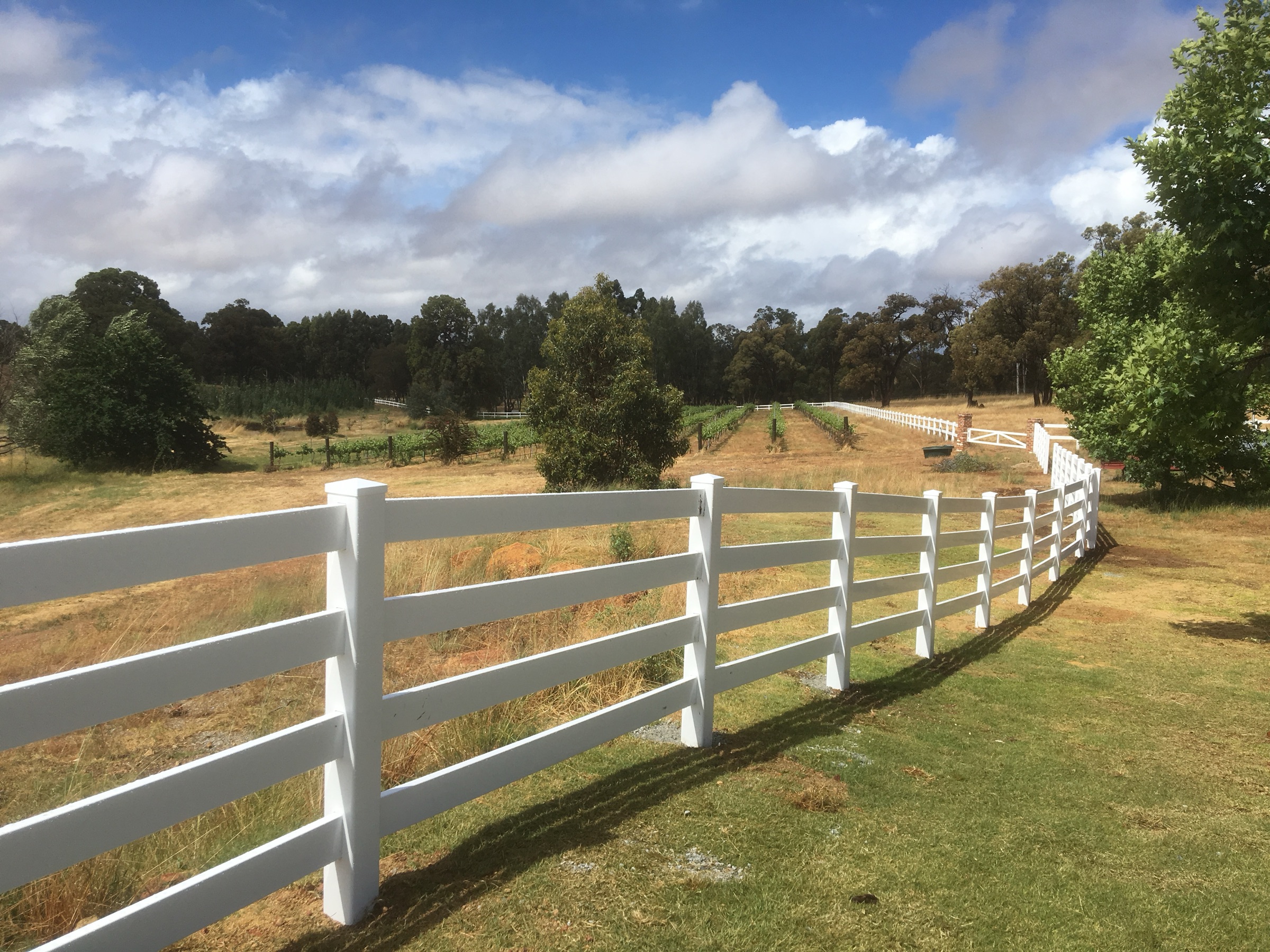
Stepped (stair-stepped): Each bay's rails are perfectly level, but each bay sits lower or higher than the one next to it. At each post, there's a visible step down (or up). This is the more common approach for PVC fencing and works on any gradient.
Raked (angled): The rails follow the slope of the ground at an angle, so the fence flows with the terrain rather than stepping. This gives a smoother look but only works on gentle slopes — generally up to about 15 degrees. Your posts and panel profiles need to be set up for raking, so this should have been planned before the posts went in.
Installing Panels and Pickets
With the rails in place, you can start fitting the panels or pickets. This is the part that goes quickly — if your posts and rails are right, the panels slot in without much fuss.
Privacy panels
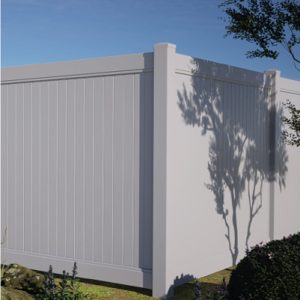
Privacy panels (the solid tongue-and-groove boards) slide into the rails from above, one at a time. Start at one end of the bay and work your way across. Each board slots into the groove of the one beside it. They should sit flush with no gaps between them.
Once all the boards are in the bay, fit the top rail over the top to lock everything in place. Check that the panels are sitting evenly — all the same height, all flush, no boards sticking up higher than others.
Pickets
Pickets fit into the top and bottom rails individually. The key here is consistent spacing.
Cut a small offcut to the exact gap width you want between each picket and use it as a spacer block. Place the spacer against the last picket, push the next picket up against it, then move the spacer along. This is the simplest way to keep your spacing even from one end of the bay to the other.
If you're doing a long run, check the spacing every few pickets by measuring from the first picket to where you are. Small errors accumulate — if each gap is off by just one millimetre, you'll be 20mm out by the twentieth picket. Checking as you go means you can make tiny adjustments before the error becomes visible.
General tips
- Work from one end to the other. Don't jump around fitting panels in random bays. Start at one end of the fence and work systematically. This keeps everything consistent and you won't accidentally skip a bay.
- Keep checking as you go. After each bay, step back and look along the fence line. Are the panels sitting evenly? Is the top rail straight? Does anything look off?
- Have a rubber mallet handy. If a board or picket needs a gentle tap to seat properly, use a rubber mallet — not a hammer. A rubber mallet gives you control without overdoing it.
Cutting Panels to Fit
In most fence runs, the last bay won't be a full panel width. You'll need to cut panels or pickets to fill the remaining gap.
How to measure
Measure the gap between the last full panel and the post channel. Measure at the top and at the bottom — if the posts aren't perfectly parallel, the measurements may differ slightly. Use the smaller measurement so the panel fits.
How to cut
PVC cuts cleanly with the right blade. Use a fine-tooth saw — either a hand saw with a fine-tooth blade, or a drop saw (mitre saw) with a fine-tooth blade designed for timber or PVC. A standard wood blade works, as long as it has fine teeth. Avoid coarse blades, as they'll leave a rough edge.
- Mark your cut line clearly on both sides of the panel using a pencil and straight edge.
- Cut from the back of the panel where possible, so any minor roughness on the exit side of the cut faces away from the visible side.
- Let the saw do the work. Use steady, even pressure. Pushing too hard can cause the PVC to flex or the cut to wander.
- Sand the cut edge smooth with fine sandpaper (180 grit or similar). A quick pass takes off any rough spots and gives you a clean finish.
If you're cutting multiple panels to the same width — for example, if you have the same gap at both ends of a long fence — cut one first, check the fit, and then use it as a template for the rest.
Post Caps and Finishing
Post caps are the finishing touch. They sit on top of each post, keep water out of the hollow post interior, and give the fence a clean, finished look.
Most PVC post caps are a push fit — they press down over the top of the post. Some people add a small dab of PVC adhesive to the inside of the cap for extra security, which is worth doing if you're in an area that gets strong winds. If you're using adhesive, apply a thin bead to the inside edges of the cap, press it firmly onto the post, and let it set.
Check that each cap is sitting straight and level. Stand at one end of the fence and look along the post tops — the caps should all be aligned and at a consistent height.
Gates
If your fence includes a gate, this is where you fit it. Gate installation is straightforward, but there are a few things to get right.
Gate posts
Your gate posts should already be set deeper and with more concrete than your standard fence posts. They take more load because the gate hangs from one side and swings, so they need to be solid. If you followed the post-setting guide, this should already be sorted.
Hanging the gate
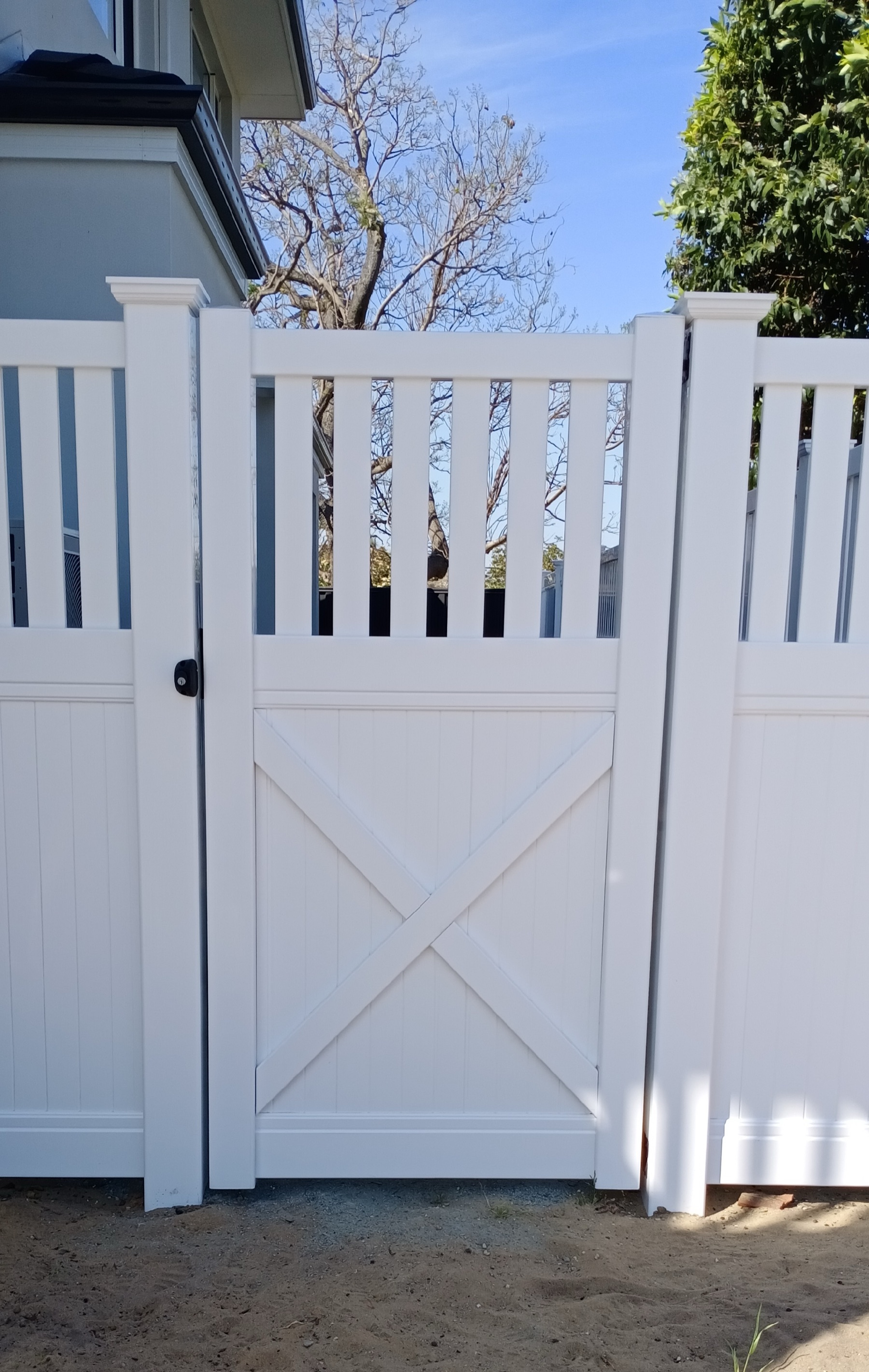
- Hinges go on one side, latch on the other. Hold the gate in the opening and mark the hinge positions — position hinges near the top and bottom of the gate frame, and check the hinge manufacturer's recommendations for exact placement. PVC gates have internal aluminium reinforcement, so your hinge screws need to go into that reinforcement for a secure fixing.
- Pre-drill pilot holes in both the gate and the post before driving in the screws. This stops the PVC from cracking and gives you a cleaner result.
- Check the swing. The gate should open and close freely without dragging on the ground or catching on the post. If it's rubbing, adjust the hinge positions until the swing is clean.
- Fit the latch. Check that the gate latches securely from both sides and that it's at a comfortable height to reach.
Pool fence gates
If your gate is part of a pool fence, it has to meet the requirements of Australian Standard AS 1926.1. That means the gate must be self-closing from any open position and self-latching, with the latch at least 1.5 metres above ground level. Test the self-closing mechanism before you finish up — open the gate to various positions and make sure it swings closed and latches every time. This is a safety requirement and councils inspect for it.
Final Checks
Once everything is in place, walk the entire fence line — both sides — and check the following:
- All panels sitting evenly. No boards sticking up, no gaps where there shouldn't be any, no panels sitting higher in one bay than another.
- All posts plumb. Give each post a final check with the spirit level.
- All post caps on and aligned. Look along the top of the fence from one end — the caps should form a consistent line.
- Gates swinging and latching properly. Open and close each gate a few times. Check that hinges are tight and latches engage cleanly.
- No panels installed the wrong way around. Some panel profiles have a front and a back — make sure the face you want to see is facing the right direction.
- Rails are sitting in their channels. Run your hand along each rail where it meets the post to make sure nothing has shifted during panel installation.
Then stand back. Look at the fence from the street side and from the yard side. Walk along it from a distance. Does it look straight and even? Does the top line flow consistently? If something catches your eye, now is the time to fix it — not next week.
What to Do if Something's Not Right
Most issues at this stage come down to something that happened earlier in the build. Here are the common ones and what to do about them.
A panel isn't sitting level. Check the rail underneath — if the rail isn't level, the panels above it won't be either. You may need to remove the panels, adjust the rail, and refit them.
There's a gap at the bottom of the fence. This usually means the ground isn't level under that bay, or the bottom rail is sitting higher than it should. If the gap is small, you can live with it — some ground clearance actually helps prevent water pooling against the panels. If the gap is large and you need it closed, you may need to adjust the rail position or add a gravel board.
A post is slightly off plumb. If the concrete is fully set, you're working with what you've got. A slightly off-plumb post won't cause structural problems, but it will affect how the panels sit in that bay. You can sometimes compensate by adjusting the rail position slightly. If a post is significantly off, it may need to be reset — which means cutting it out and starting that post again.
The gate is dragging or not latching. Check the hinge screws — they may need tightening. Check that the gate post hasn't moved. Adjust the hinge position up or down, or adjust the latch strike plate, until the gate swings and latches cleanly.
You've got a question we haven't covered here. Give us a call on (08) 9300 9220. We talk people through installation questions all the time and we're happy to help you work through whatever's come up.
Want an installer instead? If you've started the job and decided you'd rather have someone finish it off, or if you'd prefer a professional to do the whole thing, we can connect you with an experienced local installer who works with PVC fencing regularly. Give us a call and we'll sort it out.
DIY fencing series:
- Planning your DIY PVC fence — everything to sort out before you start
- How to set a string line for fencing — the foundation of a straight fence
- How to set PVC fence posts — post holes, concrete, and getting them plumb
- Installing PVC fence panels and rails — you are here
This guide is general information for installing PVC fence panels in Australia. Site conditions, product specifications, and local requirements vary. Always follow the installation instructions supplied with your specific Probuild product, and check with your local council if you're unsure about any compliance requirements.