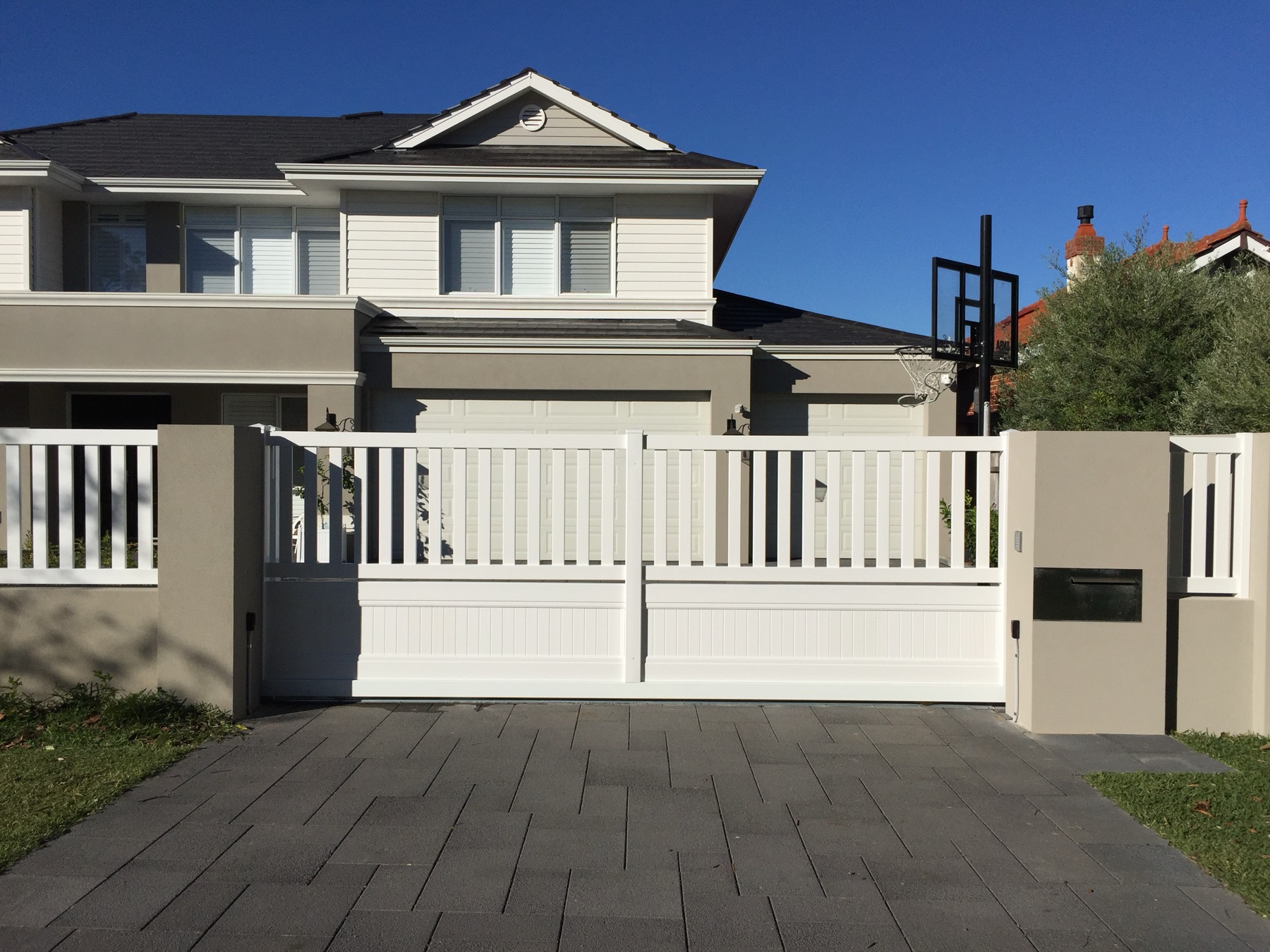
Electric sliding gates are a different beast from standard fencing. They're part mechanical, part electrical, part structural – and getting all three right on the same job takes specialist knowledge that most fencing contractors don't carry. If you're a homeowner looking at an electric sliding gate for your driveway, or a contractor whose customer has asked about one, this guide covers what's actually involved – the design process, what it costs, how it's installed, and what to look out for.
We manufacture and install custom electric sliding gates at Probuild, and it's one of the few things we handle from start to finish – manufacturing the gate, fitting the automation, and commissioning it on site. We do it ourselves because the quality of the finished product depends on getting every part of the job right, and that's hard to guarantee if different trades are piecing it together.
Why Most Fencing Contractors Don't Do Sliding Gates
This isn't a criticism of fencing contractors – it's just the reality of what's involved. A standard fencing job is posts, rails, and panels. It's physical work, but the skill set is well understood and most experienced fencers can do a great job of it.
An electric sliding gate is a completely different type of project. You need to understand track engineering – how the gate sits on and moves along a ground track or is suspended from a top rail. You need to size and mount an automation motor correctly so it can handle the weight of the gate without burning out. You need electrical work for the motor, safety sensors, and any intercom or access control. And you need to get the concrete footings right, because the motor mount and track have to stay perfectly level for the gate to operate smoothly over years of use.
Most fencing contractors are honest about this – they'll tell the customer it's outside their scope. The ones who aren't honest about it are the ones who end up with a gate that jams, a motor that fails after six months, or a track that shifts because the footings weren't adequate.
It's specialist work, and that's why we handle it ourselves rather than leaving it to others.
The Design Process
Every electric sliding gate is custom. There's no standard size, no off-the-shelf kit that works for every driveway. The design process starts with a site visit, because measurements from a photo or a description over the phone aren't enough when you're dealing with automation.
What we assess on site
- Width of the opening – the gate needs to be wider than the opening so it covers the full driveway when closed, with enough overlap on each side.
- Clearance for the gate to slide – when the gate opens, it has to go somewhere. You need at least the same distance as the gate width on one side of the opening, clear of obstacles like garden beds, retaining walls, or downpipes.
- Ground slope – if the driveway or the fence line slopes, the track and gate have to be designed to accommodate that. A gate that works perfectly on flat ground can jam or derail on a slope if it hasn't been engineered for it.
- Ground conditions – the track and motor mount need solid footings. Sandy soil (common across Perth) behaves differently to clay, and the footing design has to account for that.
- Power supply – the motor needs electricity. We'll check where the nearest power point is and whether you need an electrician to run a dedicated circuit.
- Access control – do you want a simple remote control, a keypad, an intercom, or integration with a smart home system? This affects the wiring and the automation unit we specify.
- Existing fencing and structures – the gate needs to match or complement what's already there, and we need to check that existing posts and piers can accommodate the track and guide rollers.
After the site visit, we put together a design that covers the gate dimensions, materials, automation system, and a quote for the full job – supply and installation.
Materials and Construction
Our sliding gates are built on a structural aluminium or steel frame with PVC panels. The frame provides the strength and rigidity the gate needs to span wide openings without sagging, while the PVC panels give you the look – whether that's a privacy panel, a slatted design, or something that matches your existing fencing.
The gate itself
- Frame: Aluminium or galvanised steel, depending on the span and weight requirements. Aluminium is lighter and doesn't corrode, which matters in coastal areas. Steel is used for larger, heavier gates where maximum rigidity is needed.
- Panels: PVC in your choice of style and colour. Because we manufacture PVC fencing, we can match the gate to your fence line exactly – same profile, same colour, same finish.
- Track system: A ground-level steel track that the gate runs along on guide wheels. The track is set into concrete so it stays level and stable.
- Guide rollers: Top and bottom guide rollers keep the gate aligned as it moves. These are nylon or steel, depending on the gate weight.
The automation
- Motor: We use commercial-grade gate automation systems from established manufacturers – brands like BFT, FAAC, and Nice, which are Italian-made and have proper parts availability and technical support in Australia. The motor is sized to the weight of the gate, with headroom for years of reliable operation.
- Safety sensors: Photoelectric sensors detect obstructions in the gate's path and stop or reverse the gate automatically. These are a safety requirement under Australian standards.
- Remote control: Standard with every installation. Most systems support multiple remotes, so each member of the household can have their own.
- Optional extras: Keypads, intercoms, smartphone control, integration with home automation systems. We can talk you through what makes sense for your property.
What It Costs
We're not going to dance around this – electric sliding gates are a significant investment. A custom electric sliding gate, fully supplied and installed, typically costs between $6,000 and $10,000 or more, depending on the specifics of the job.
What drives the price
| Factor | How it affects cost |
|---|---|
| Gate width | A wider gate means more material, a heavier frame, a more powerful motor, and a longer track. A 3-metre gate is a different job to a 6-metre gate. |
| Gate height | Taller gates need a stronger frame to prevent flex and sagging. Height also affects wind loading, which means a more robust motor and mounting. |
| Automation system | A basic remote-controlled motor is the entry point. Add an intercom, keypad, or smart home integration and the cost increases. Commercial-grade motors from brands like BFT or FAAC cost more than budget units, but they last longer and have proper parts support. |
| Ground conditions | Rocky ground or deep sand means more work on footings. A sloped site adds complexity to the track design. |
| Electrical work | If a new power circuit needs to be run to the gate location, that's additional cost from a licensed electrician. |
| Panel design | A simple privacy panel is more straightforward to manufacture than a slatted or decorative design. Custom profiles or decorative panel designs add to the manufacturing time. |
A note on price: You'll find cheaper options online – imported gate kits, DIY automation packages, budget motors. The reason our gates cost what they do is that we're manufacturing the gate to fit your specific opening, using a motor that's properly sized for the weight, installing it on engineered footings, and commissioning it with safety sensors calibrated to Australian standards. That's what makes the difference between a gate that works reliably for 15+ years and one that gives you problems within a couple of seasons.
Sliding Gates vs Swing Gates
People sometimes ask whether a swing gate would be a better option. It depends on the property, but there are good reasons why sliding gates are more common for driveway automation in Perth.
| Sliding gate | Swing gate | |
|---|---|---|
| Space needed | Slides along the fence line – doesn't take up driveway space | Needs a full arc of clearance to swing open, either inward or outward |
| Sloped driveways | Works well on slopes – the track follows the ground | Difficult on slopes – the gate can scrape the ground as it swings |
| Wind | Minimal wind impact – the gate moves sideways, not into the wind | Large swing gates act like a sail in strong wind, which strains the motor and hinges |
| Security | Very secure – the gate sits in a track and is difficult to force open | Less secure – hinges and latches are the weak points |
| Wide openings | Can span very wide openings (6 metres+) | Becomes impractical above about 4 metres – the gate is too heavy and the swing arc too large |
| Cost | Generally more expensive due to track, motor, and engineering | Simpler and cheaper for smaller, flat openings |
For most Perth driveways – especially where space is tight, the ground isn't perfectly flat, or you need a wide opening – a sliding gate is the more practical choice. Perth also gets serious sea breezes in summer, and sliding gates handle wind much better than swing gates.
The Installation Process
Here's what happens on the day, so you know what to expect.
Day one
- Concrete footings – we dig and pour the footings for the motor mount, the end stop, and the guide posts. The track footing is a continuous concrete beam that runs the full length of the gate's travel. These need to cure, so on some jobs we'll pour footings on a separate visit before the main installation day.
- Track installation – the steel ground track is set into the concrete, levelled precisely, and aligned with the gate opening. Even a few millimetres of deviation will cause problems, so this step takes time and care.
- Guide post installation – the guide posts at either end of the track are set in concrete and fitted with guide rollers that keep the gate on track as it moves.
Day two (or later on day one, depending on the job)
- Gate hanging – the gate is lifted onto the track and into the guide rollers. We check that it moves freely along the full length of the track before connecting the motor.
- Motor mounting – the automation motor is bolted to its concrete footing and connected to the gate via a drive rack (a toothed rail on the bottom of the gate that the motor gear engages with).
- Electrical connection – a licensed electrician connects the motor to the power supply. Safety sensors, remotes, and any access control (intercom, keypad) are wired in at this stage.
- Programming and testing – the motor is programmed for the gate's travel distance, speed, and auto-reverse sensitivity. We test the gate through dozens of open-close cycles, check the safety sensors from multiple angles, and make sure the manual override works properly.
- Handover – we walk you through operating the gate, explain the manual release (for power outages), hand over the remotes, and go through the basic maintenance schedule.
Most residential installations take one to two days, depending on the complexity of the job and whether footings need a separate pour-and-cure visit.
Council Requirements in WA
If your sliding gate is in the front setback area (which most driveway gates are), it needs to comply with the same rules that apply to front fencing in your local council area.
Key things to check
- Height limits: Most WA councils allow front fences and gates up to 1.2 metres solid, with the section above that needing to be visually permeable (meaning it has gaps or openings). Total height is usually capped at 1.8 metres. If your gate needs to be taller, you'll likely need development approval.
- Driveway truncation: Within 1.5 metres of where the driveway meets the footpath, the fence or gate can't be higher than 750mm. This is a safety requirement for driver visibility. Your gate design needs to account for this – the gate itself might comply, but the guide posts and motor housing also need to sit within the limits.
- Setback from the property boundary: The gate shouldn't swing or slide across the footpath or verge. For a sliding gate, this means the gate and track need to be entirely within your property boundary.
- Development approval: Some councils require a development application (DA) for automated gates, particularly if the gate exceeds standard height limits or is in a heritage area. The DA process varies by council – some are straightforward, others take weeks. We can advise you on what your council is likely to require based on the site visit.
For trade partners: If you're quoting a fencing job and the customer also wants an automated gate, check the council's front fence rules before you quote. Gate height, permeability, and driveway truncation rules affect the design. If you're not sure, give us a call and we can help you work through it.
Safety Requirements
Automated gates are covered by Australian safety standards, and there are good reasons for every requirement. A sliding gate is a heavy object moving under motor power – the safety features are there to prevent injuries, and they're not optional.
What's required
- Photoelectric safety sensors: These detect obstructions in the gate's path – a person, a pet, a car, a bin. If the beam is broken, the gate stops or reverses automatically. Sensors must be placed along the moving path of the gate to prevent entrapment.
- Auto-reverse: If the gate contacts an obstruction, it must reverse automatically. Australian standards specify that the crushing force must not exceed 400 Newtons before the gate starts to reverse, and must reduce to below 150 Newtons within 750 milliseconds. This is a very specific requirement that needs proper calibration – it's not something you can guess at.
- Manual override: Every automated gate must have a manual release mechanism so you can open it by hand during a power outage or motor failure. This is usually a key-operated release on the motor unit.
- Warning signage: A sign indicating the gate is automated should be visible from both sides.
Why the automation brand matters
Budget gate motors from unknown manufacturers are tempting because of the price, but they're a false economy. The safety sensor integration on cheap units is often unreliable – sensors that don't trigger consistently, auto-reverse that doesn't meet the force limits, or software that glitches and leaves the gate stuck mid-travel.
Commercial-grade automation from brands like BFT, FAAC, or Nice is designed to meet these safety standards reliably over thousands of cycles. They also have proper parts availability in Australia, so if a component fails in five or ten years, you can get a replacement rather than scrapping the whole unit.
We use these brands because we need to stand behind the finished product, and we can't do that if the automation is unreliable.
Maintenance
One of the advantages of a well-installed sliding gate is that it doesn't need much ongoing attention. But "not much" isn't "none" – here's what's involved.
Regular maintenance (every 3-6 months)
- Track cleaning: Leaves, dirt, and gravel accumulate in the ground track over time. A quick sweep or hose-out keeps the gate running smoothly. If the track gets blocked, the gate can jam or the motor can strain trying to push through the debris.
- Guide roller check: Make sure the rollers spin freely and aren't worn. These are a wear item and will need replacing eventually, but they're inexpensive and easy to swap.
- Safety sensor test: Place an object in the gate's path and check that the sensors detect it and the gate stops or reverses. This takes 30 seconds and gives you peace of mind.
Annual maintenance
- Motor service: A professional check of the motor, drive gear, and electrical connections. Most automation manufacturers recommend an annual service to keep the warranty valid and catch any issues early.
- Auto-reverse calibration: The force settings should be checked and recalibrated if needed to make sure they still meet safety requirements.
The PVC advantage
The gate panels themselves are PVC, which means no painting, no rust treatment, no re-oiling, and no replacement of rotting boards. A wash with soapy water a couple of times a year keeps them looking new. If you've ever maintained a timber gate, you'll appreciate the difference.
Common Questions
Can I automate my existing gate?
Sometimes, but it depends on the gate. The gate needs to be structurally sound, the right weight for a motor, and compatible with a track system. In many cases, retrofitting automation to an old gate costs nearly as much as a new gate and automation together, because the existing gate wasn't designed for it. We can have a look at what you've got and give you an honest assessment of whether it makes sense to automate it or start fresh.
How wide can a sliding gate be?
We've built sliding gates spanning 6 metres and wider. The wider the gate, the heavier it is and the more powerful the motor needs to be. Very wide openings (8 metres+) sometimes need a telescopic design where two gate panels nest behind each other, so the clearance required on the slide side is halved. We'll talk you through the options during the site visit.
What happens in a power outage?
Every gate we install has a manual release mechanism – you unlock it with a key and slide the gate open by hand. Some automation systems also have battery backup options that give you a limited number of open-close cycles during a power outage. We can fit battery backup if it's important to you.
Do I need an electrician?
Yes. The motor needs to be connected to mains power by a licensed electrician. This is a legal requirement in Western Australia – you can't wire it yourself. We coordinate the electrical work as part of the installation, so you don't need to organise a separate trade.
How long does a sliding gate last?
The PVC panels and aluminium or steel frame will last decades with minimal maintenance – PVC doesn't rot, rust, or need recoating. The automation components (motor, sensors, remotes) have a lifespan that depends on usage and maintenance, but with a quality motor and annual servicing, 15-20 years of reliable operation is realistic. When the motor eventually needs replacing, the gate itself is still in good condition – you're only replacing the automation, not the whole gate.
Can I add an intercom or smart access later?
Yes. We wire for future access control during installation even if you don't want it straight away, so adding an intercom, keypad, or smartphone control later is straightforward and doesn't require pulling up concrete or re-running cables.
Why Probuild Does This In-House
We supply and install custom electric sliding gates ourselves because the quality of the finished gate depends on every part of the process being done right – from manufacturing the PVC panels and building the frame, through to setting the track, mounting the motor, and calibrating the safety systems.
When we manufacture the gate, we know exactly what it weighs, how it's constructed, and what motor it needs. When we install it, we know how the track needs to be set for that specific gate. When we commission the automation, we know the force limits, the sensor positions, and the programming parameters. There's no gap between what was designed and what gets built on site, because the same team handles both.
That's also why we can stand behind the finished product. If something needs adjusting after installation – and occasionally it does, because gates settle and ground shifts – you call us and we sort it out. You're not trying to work out whether the problem is the gate, the motor, or the installation, and you're not chasing three different suppliers to get it fixed.
For Contractors
If you're a fencing contractor and your customer asks about an electric sliding gate, here's the straightforward version: we handle the gate, you handle the fencing. You can refer the sliding gate enquiry to us and we'll look after your customer – they get a specialist installation, you don't have to take on work that's outside your usual scope, and the customer ends up with a gate that matches their new fence perfectly because we're manufacturing both.
This works well for contractors who want to offer their customers a complete solution without having to invest in gate automation skills, equipment, and liability. The fencing is your job and you do it well. The automated gate is ours.
If you're already a Probuild trade partner, you can refer a sliding gate enquiry through the trade portal or give us a call directly. If you're not a trade partner yet and you'd like to know how it works, get in touch – we're happy to talk you through it.
Want to talk about a sliding gate project? Give us a call on (08) 9300 9220 and we'll talk you through what's involved for your property. If you'd like us to come out and have a look at the site, we can organise a visit at a time that works for you.
This guide is general information about electric sliding gate design, cost, and installation in Western Australia as at March 2026. Every property is different, and the specifics of your project – dimensions, ground conditions, automation requirements, and council rules – will affect the design and cost. Give us a call for advice on your specific situation.